Unsubscribe
To unsubscribe, please enter your e-mail address below or send us an e-mail at unsubscribeeu@blueprintmedicines.com
Please enter a valid e-mail address
SM presents with symptoms from skin lesions to fatigue that diminish everyday living, to organ damage that can reduce survival1–3
Mast cell-mediator symptoms in SM can be unpredictable and identifying the underlying disease often takes years. SM symptoms can be triggered by aspects of everyday life, including heat, stress, exercise and food, although these triggers vary considerably and are not always representative1
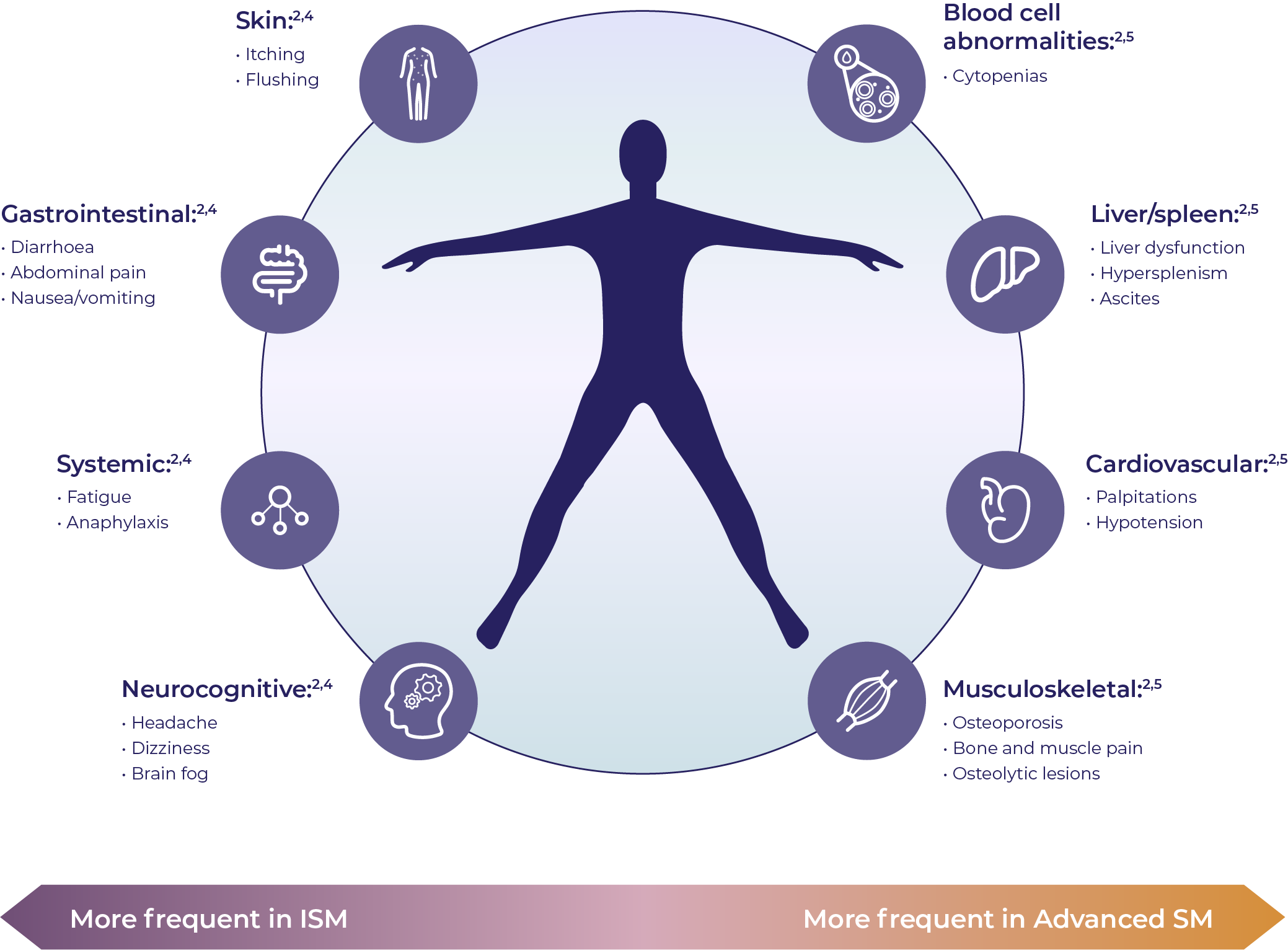
Note: Not an exhaustive list of possible symptoms. The frequency and intensity of any given symptom may vary from person to person.
Common symptoms such as skin lesions, anaphylaxis and diarrhoea should raise suspicion of SM1,2,6
Download the symptom checklist to help you recognise the symptoms or features indicative of SM
 Skin
Skin
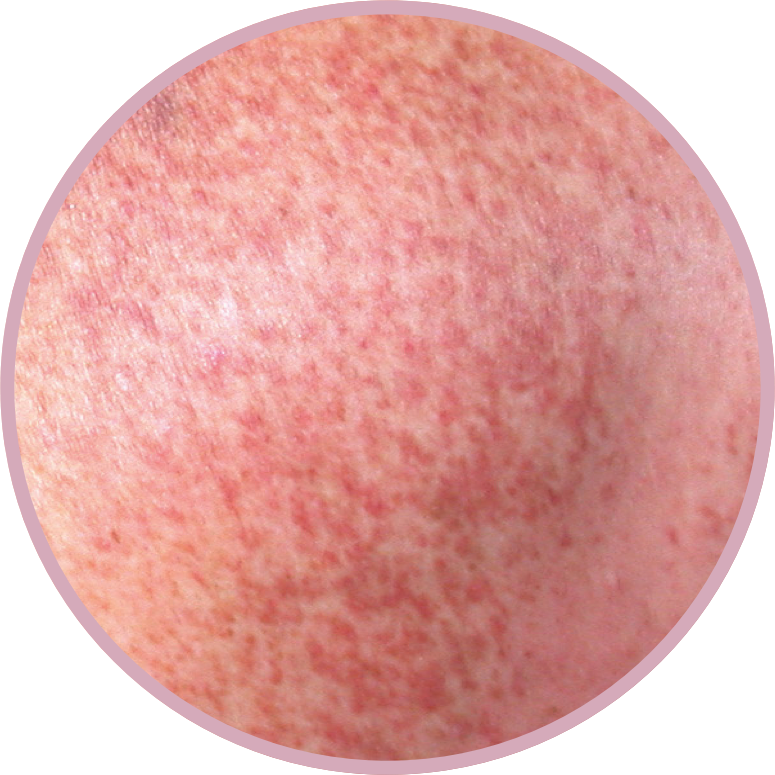
It is estimated that around 95% of ISM patients and around 50% of Advanced SM patients experience maculopapular skin lesions7*
Small monomorphic lesions often appear on the thighs or trunk of the body7
A wheal-and-flare reaction is induced by stroking lesions mechanically, e.g. with tongue spatula7
In the PRISM trial, 28% of patients with SM stated skin symptoms as their most bothersome symptom3†
Download the skin lesions leaflet to learn more
 Blood cell abnormalities
 Liver/spleen
 Musculoskeletal
2
Consider further diagnostic workup in patients with persistent or unexplained symptoms, especially when accompanied by abnormal blood counts or suspected myeloid neoplasms6,8,9
 Systemic
 Neurocognitive
Any patient living with SM can present with potentially severe symptoms, from brain fog and fatigue to life-threatening anaphylaxis, that diminish everyday quality of life:1-3
About 33% of patients living with SM experience anaphylaxis;1‡ it is commonly triggered by hymenoptera stings or may occur as unexplained or idiopathic anaphylaxis5
At least 60% of patients living with SM experience difficulty concentrating or bothersome fatigue1‡
The unpredictable onset of acute symptoms is a main reason that patients with mast cell diseases seek support1
*As described by the expert panel review of adult-onset mastocytosis (predominantly indolent population) in the Hartmann 2016 study.7
†Based on data from the EU PRISM Patient Survey on the impact of SM (N=540).3
‡Based on data from the Mast Cell Connect Registry (N=163) in the Jennings 2018 study.1
Recognising severe and recurrent instances of the common symptoms can help raise suspicion of SM, even within a concomitant diagnosis6
Initial screening upon suspicion can guide the need for next steps or referral
Screening following referral can help confirm or rule out the diagnosis
Jennings SV, et al. Immunol Allergy Clin North Am. 2018;38(3):505–525.
Pardanani A. Am J Hematol. 2023;98(7):1097–1116.
Triggiani M, et al. Clin Exp Allergy. 2025;55(9):784–794.
van Anrooij B, et al. Allergy. 2016;71(11):1585–1593.
Gülen T, et al. J Intern Med. 2016;279(3):211–228.
Valent P, et al. J Allergy Clin Immunol Pract. 2022;10(8):1999–2012.e6.
Hartmann K, et al. J Allergy Clin Immunol. 2016;137(1):35–45.
Rets A, George TI. Int J Lab Hematol. 2025. doi: 10.1111/ijlh.70011. Online ahead of print.
Schwaab J, et al. J Allergy Clin Immunol Pract. 2020;8(9):3121–3127.e1.
Want to learn more about Systemic Mastocytosis?
Visit our Resources Page for more information.
Take me there!Sign up for email updates, news and resources on Systemic Mastocytosis from Blueprint Medicines, as well as other diseases relevant to your medical specialisation. We will also share information relevant to Blueprint Medicines’ products and other promotional activities and events

You can unsubscribe at any time by sending us an email at unsubscribeeu@blueprintmedicines.com or by clicking on the Unsubscribe link in the footer of this website or each future email communication by Blueprint Medicines