Unsubscribe
To unsubscribe, please enter your e-mail address below or send us an e-mail at unsubscribeeu@blueprintmedicines.com
Please enter a valid e-mail address
SM has an incidence of ~1 in 10,000 adults1* and is driven by an accumulation of abnormal mast cells causing varied signs and symptoms2,3
The World Health Organization (WHO) classifies SM into 6 subtypes, grouped into non-Advanced and Advanced forms:4
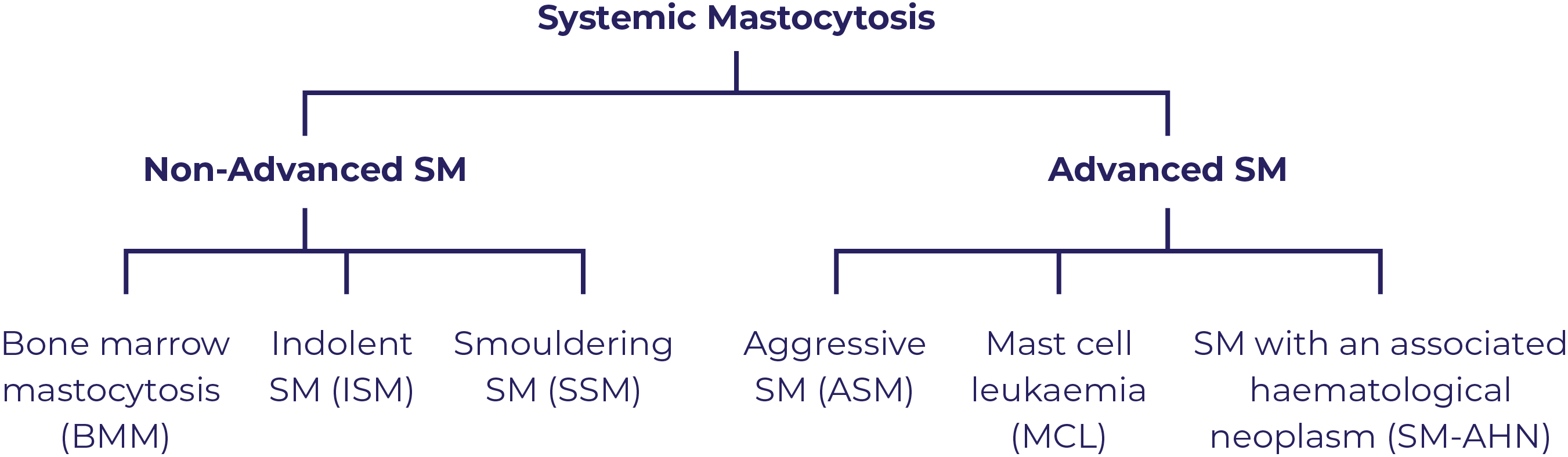
Modified from Khoury JD, et al. Leukemia. 2022;36(7):1703–1719.
Indolent systemic mastocytosis (ISM) is the most common subtype, characterised by mast cell mediator-related symptoms, while the Advanced SM group is primarily characterised by organ damage and possible organ failure2,3
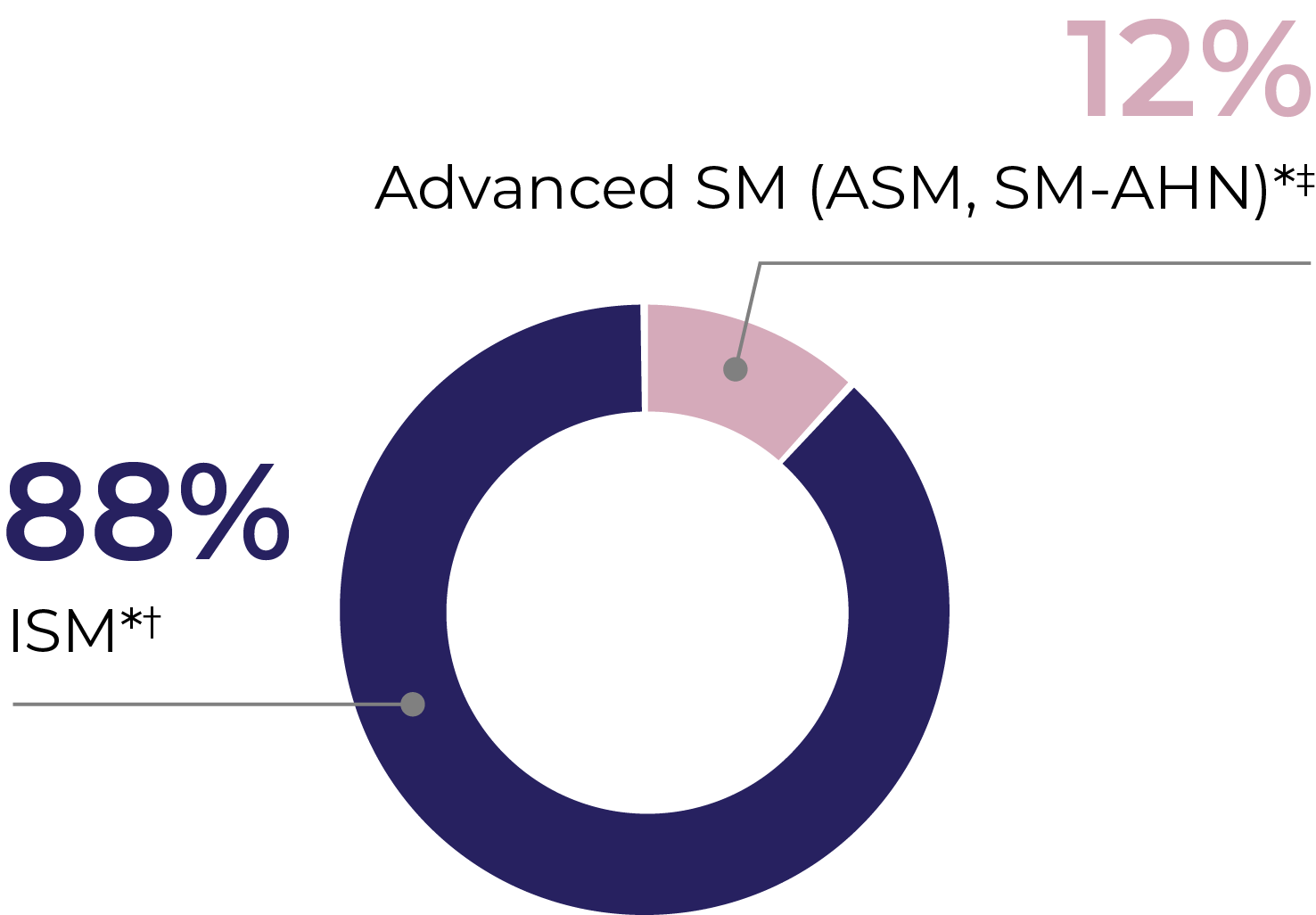
*Based on a 15-year retrospective study of a Swedish cohort of 195 consecutive SM patients diagnosed in 2006–2020.1
†Includes three patients with SSM; Of the ISM patients, 47 had no typical skin lesions (27.8%) and obtained the diagnosis of BMM.1
‡There were no cases of MCL in this cohort.1
Many patients living with SM report uncontrolled disease and impaired quality of life, despite polypharmacy with symptom-directed therapies8–10
Mast cells in the body rely on stem cell factor (SCF), also known as KIT ligand, to regulate their growth, maturation and function. SCF is typically released in response to triggers like tissue damage or inflammation and binds to the KIT receptor, activating signalling pathways that guide mast cell development and activity.9 In SM, the KIT D816V mutation is found in ~95% of cases.1,11 This mutation causes the KIT receptor to remain constantly active, driving uncontrolled mast cell proliferation and activation. This can result in excessive mediator release, causing a wide range of symptoms across multiple organs.9
Download the KIT testing pocket card to learn more about KIT D816V testing as part of the SM diagnostic workup
"Mastocytosis is a complex disorder, in terms of its pathophysiology, clinical and molecular side."Dr Jonathan Lambert
Download the HCP leaflet and SM infographic to learn more about SM
Ungerstedt J, et al. Cancers (Basel). 2022;14(16):3942.
Pardanani A. Am J Hematol. 2023;98(7):1097–1116.
Gülen T, et al. J Intern Med. 2016;279(3):211–228.
Khoury JD, et al. Leukemia. 2022;36(7):1703–1719.
Jennings SV, et al. Immunol Allergy Clin North Am. 2018;38(3):505–525.
Mesa RA, et al. Cancer. 2022;128(20):3691–3699.
Lim K-H, et al. Blood. 2009;113(23):5727–5736.
Mesa RA, et al. Cancer. 2022;128(20):3700–3708.
Gilreath JA, et al. Clin Pharmacol. 2019;11:77–92.
Triggiani M, et al. Clin Exp Allergy. 2025;55(9):784–794.
Kristensen T, et al. J Mol Diagn. 2011;13(2):180–188.
Want to learn more about Systemic Mastocytosis?
Visit our Resources Page for more information.
Take me there!Sign up for email updates, news and resources on Systemic Mastocytosis from Blueprint Medicines, as well as other diseases relevant to your medical specialisation. We will also share information relevant to Blueprint Medicines’ products and other promotional activities and events

You can unsubscribe at any time by sending us an email at unsubscribeeu@blueprintmedicines.com or by clicking on the Unsubscribe link in the footer of this website or each future email communication by Blueprint Medicines